Sekabet Payments — Deposits, Withdrawals, Times and Real Limits
Depositing is easy everywhere; an operator gets judged when you ask for your money back. Here are the active methods, the real times through to funds landing, the ceiling of roughly €5,000 every 24 hours, the KYC documents required, and the seven reasons a withdrawal sits marked "pending". Figures are indicative: Sekabet publishes no official table.
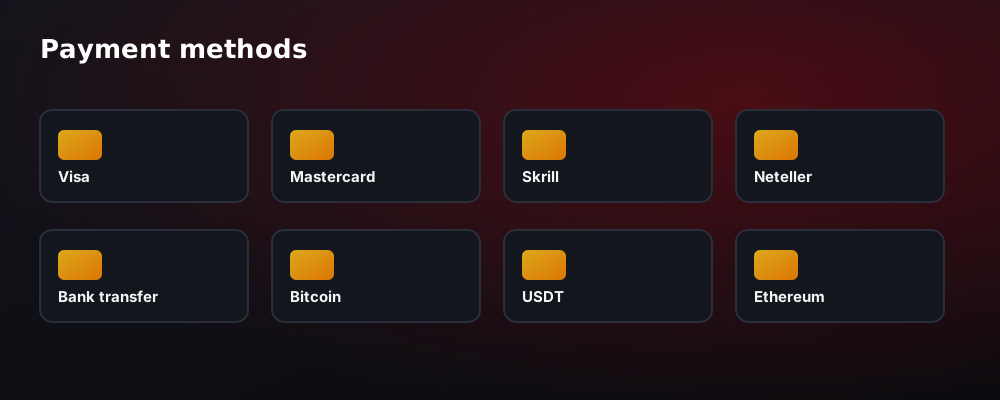
Deposit methods
The cashier covers three families of instrument: cards, e-wallets when outbound speed matters, and cryptocurrency for skipping banks entirely. The minimum is €20 almost everywhere, the same threshold that triggers the welcome offer, and funds land immediately unless you pick a bank transfer.
| Method | Credit time | Min deposit | Indicative max | Fee |
|---|---|---|---|---|
| Visa / Mastercard | Instant | €20 | €4,000 per transaction | None |
| Skrill | Instant | €20 | €5,000 | None |
| Neteller | Instant | €20 | €5,000 | None |
| Bank transfer | 1-3 business days | €50 | €10,000 | Bank charges |
| Bitcoin (BTC) | 10-40 minutes | ~€20 equivalent | No fixed cap | Network fee |
| USDT (TRC-20 / ERC-20) | 5-20 minutes | ~€20 equivalent | No fixed cap | Network fee |
| Local methods (region-dependent) | Instant to 1 day | ~€20 equivalent | Varies | None from the operator |
Two warnings before you choose. The channel you pay in with dictates the one you cash out through, so think about the exit before the entrance. And expect that some banks decline payments to operators without a domestic licence — in the UK, card gambling deposits are blocked outright by law, and issuers in India and elsewhere apply their own filters. Pushing at a declining card wastes time, while an e-wallet or crypto usually goes through first attempt. Availability of local rails such as bank-app transfers varies by country and by the payment partners active at the time.
The brand also offers P2P Transfer, a direct move between player accounts. Treat it as a fallback: it needs both accounts verified and leaves you without the protections of a traceable payment.
Withdrawal methods and real timings
The time printed in the cashier is not the time you wait. Every withdrawal passes through two phases: internal approval, an anti-fraud check taking anything from a few hours to 24 (48 at weekends), and processing on the method, which is the only part shown below.
| Method | Processing time | Min withdrawal | Daily limit | Fee |
|---|---|---|---|---|
| Skrill | 1-12 hours | €30 | ~€5,000 / 24h | None |
| Neteller | 1-12 hours | €30 | ~€5,000 / 24h | None |
| USDT (TRC-20) | 30 minutes - 3 hours | ~€50 equivalent | ~€5,000 / 24h | Network fee |
| Bitcoin (BTC) | 1-6 hours | ~€50 equivalent | ~€5,000 / 24h | Network fee |
| Visa / Mastercard | 1-3 business days | €30 | ~€5,000 / 24h | None |
| Bank transfer | 2-5 business days | €100 | ~€5,000 / 24h | Bank charges |
Across the whole offshore segment the hierarchy never changes: crypto and e-wallets pay in hours, cards and bank transfers in days. That has nothing to do with the operator's goodwill and everything to do with the technical chain. A USDT payment is one blockchain transaction and it ends there; a refund to a Visa card has to cross acquirer, scheme and issuer before it touches your account.
Limits: daily, weekly and VIP
The reference point is around €5,000 every 24 hours, entirely in line with Curaçao-licensed platforms. Note what that number measures: it governs how fast you can take money out, and places no ceiling at all on the total you can withdraw over time.
| Period | Indicative cap | In practice |
|---|---|---|
| 24 hours | ~€5,000 | One full request, then you wait for the next cycle |
| 7 days | ~€15,000-20,000 | Big sums spread across several weeks |
| 30 days | ~€40,000 | A threshold rarely met outside high-volume play |
Land a €20,000 win and forget about a single payment: the money leaves in instalments, typically €5,000 a day for four days. Standard offshore practice, though it is worth knowing in advance rather than at the wrong moment. Larger amounts also trigger a source-of-funds check.
VIP tiers matter exactly here, and this is the most concrete benefit in the whole loyalty programme: higher ceilings and priority queueing. At the lower rungs the benefit stays theoretical. Progressive jackpots follow the provider's own rules.
Account verification (KYC): what is genuinely required
Verification is the real bottleneck on a first withdrawal. Anyone mistaking it for pointless bureaucracy has it wrong: it comes from anti-money-laundering obligations that apply under a Curaçao licence too, and until it is closed no request moves. Three documents are needed.
Proof of identity
A valid passport, national ID card or driving licence, front and back, all four corners visible. First name, surname and date of birth have to match your registration: an omitted middle name is enough to get the upload rejected.
Proof of address
A utility bill, bank statement or council document issued in the last three months, with name and address legible in the same image. Mobile phone bills often fail, since they do not certify a residence.
Proof of payment method
For cards, a photo with the first six and last four digits visible, the rest covered and the CVV masked. For e-wallets, the profile screen showing email and account holder. For crypto, the transaction history is enough. And if the instrument belongs to somebody else, the withdrawal is refused without discussion.
Rejections have four recurring causes: a blurred image or flash landing on the key data, a document cropped at the edges, an expired document, or a name mismatch between profile, ID and payment method. How those files are handled is set out in the privacy policy.
How to deposit, step by step
Your first payment is also the moment the bonus attaches.
Open the cashier
Account menu, Deposit section, showing the methods active for your region.
Choose the method
Think about the exit: your withdrawal will come back through the same channel.
Enter the amount
From €20, or €50 by bank transfer. Below the threshold the welcome offer will not trigger.
Confirm the payment
Bank two-factor authentication on cards, a login on e-wallets, a generated address for crypto.
Check the balance
Instant credit except on bank transfers and crypto. With the code entered, the bonus arrives in a separate balance.
On crypto the address applies to that single transaction: sending USDT on a network other than the one shown means losing the funds. Full conditions live in the terms, and the registration walkthrough is on the sign-up guide.
How to withdraw, step by step
Two conditions have to be closed first: verification completed and no bonus with an open requirement. Without those, the request leaves but never arrives.
Open the cashier
Same area as deposits, Withdrawal tab. KYC still in progress is flagged here.
Select withdrawal
Only the channels you have already deposited with will appear.
Choose the method
On crypto, double-check address and network, because the transaction cannot be reversed.
Enter the amount
Above the minimum (€30-€100) and under the 24-hour ceiling.
Confirm and wait
Status shows "pending" during the check, then processing starts on the method.
While the status stays "pending" you can cancel the request and return the funds to play. It looks like a convenience, and for plenty of players it becomes a trap: cancelling to replay your winnings throws away all the queue time already served.
Why a withdrawal is pending: causes and fixes
A "pending" status frightens people more than it should. Almost always one of the seven situations below sits behind it, and six of them resolve without you having to contact anybody.
| Cause | What to do |
|---|---|
| KYC not completed | Upload the three documents and wait 24-72 hours. Cause number one of a stalled first withdrawal. |
| Active bonus not cleared | Finish the 40x or forfeit the bonus: the credit goes, the real balance frees up. |
| Method differs from the deposit | Request on the channel you paid in with. An alternative opens only when the first is unavailable. |
| Amount over the daily limit | Split the request into instalments within €5,000 per 24-hour cycle. |
| Weekend or public holiday | Banking steps pause: a transfer requested on Friday leaves on Monday. Crypto and e-wallets do not stop. |
| Mismatched details | Align profile, ID and the name on the payment method. A third-party account will not be paid. |
| Request cancelled | Submit it again: cancelling returns the funds to playable balance and resets the queue. |
If none of those fit and 72 working hours have passed, message live chat with the transaction ID, date, amount and method. It gets handled considerably faster than "where is my money". Keep your screenshots.
Fees: who actually charges them
Like most of the segment, Sekabet applies no fees of its own. That does not make the transfer free, though: the costs exist and somebody else along the chain collects them.
| Who charges | When and how much |
|---|---|
| Your bank | Transfer charges, usually €1-€5. Some treat a gambling payment as a cash advance on a credit card, with interest from day one. |
| The e-wallet | Skrill and Neteller take a cut on transfers to a bank account and on currency conversion, generally 1-2%. |
| The blockchain network | Depends on congestion: pennies on TRC-20, variable amounts on Bitcoin at peak hours. |
| Currency conversion | With account and instrument in different currencies, every step carries a spread. |
The most common hidden cost is the last one: on an account held in a different currency, you pay the exchange twice.
Cryptocurrency: what changes
BTC and USDT are currently the fastest way to get paid by an offshore operator, for a structural reason: the transaction never crosses a bank. Once approved it is broadcast to the network, and timing depends on block confirmations.
In practice four things change. Confirmations, since funds credit after a number of blocks rather than instantly. The network fee, which comes out of your pocket instead of the operator's. Irreversibility: get the address or network wrong and those funds are gone. And volatility, given that on BTC a 3-5% swing between deposit and withdrawal is routine.
If all you want is to move value, USDT is the sensible choice: pegged to the dollar, costing pennies on TRC-20 and confirming in minutes. Bitcoin suits those who already hold it. Either way you then need an exchange to get back into your local currency, and that is where most of the time actually goes.
Account currency and conversions
Currency is chosen once, at registration, and cannot be changed afterwards: the only route would be closing the account and opening another, with fresh KYC and no second welcome offer. Pick the currency you actually hold — euro, pound or dollar — and check the field in the form, because some sign-up flows preselect one based on your IP address.
With an instrument in a different currency, conversion is handled by the payment provider at its own rate, with a spread that is rarely disclosed, and the same applies on the way out. A note on bonuses: minimums and thresholds are set in euro, so a deposit that looks above the line can fall below it after conversion, leaving the offer unactivated.
Withdrawals with an active bonus
This rule generates more confusion than anything else in the cashier: while a bonus is still being cleared, you cannot withdraw. The requirement is 40x the bonus amount, and until that counter reaches zero, credit and winnings stay frozen.
Requesting a withdrawal early does not put you in a queue. In practice it voids the bonus along with any unconverted winnings and leaves you holding the real balance alone, which is the trade-off for having received credit up front. The arithmetic is in our bonus code guide.
From there you have two routes. If the remaining requirement is manageable, clear it on slots, which count at 100%. If it is out of reach, forfeit the bonus from the promotions panel: you lose the credit, but the real balance frees up instantly. Which games unlock what is covered in the casino guide.
Payment security
The infrastructure is what you would expect: SSL/TLS encryption on the cashier, card details held by the processor and never by the gaming server, anti-fraud monitoring on unusual activity. The closed-loop rule, where you cash out where you paid in, exists as a security measure before it is an annoyance: it renders a stolen account practically useless.
Then comes the part no promotional page writes down. Sekabet holds no UKGC or MGA licence and operates under Curaçao authorisation, which leaves your funds outside national protections: no complaint to a domestic regulator, no coverage from schemes such as GAMSTOP, no guarantee that player balances are segregated. Add that the domain can end up on blocking lists, and when the site stops responding the steadiest route becomes the Sekabet app.
Three habits lower the risk regardless: avoid leaving large balances sitting in the account, check the domain before typing your credentials, and set deposit and session limits. Strictly 18+; free and confidential support is available through BeGambleAware, GamCare, Gambling Therapy and Gamblers Anonymous, with more on our responsible gaming page.
Frequently asked questions
Indicatively €30 on cards and e-wallets, around €50 equivalent on crypto and €100 by bank transfer. The minimum deposit stays at €20.
Internal approval (up to 24-48 hours) adds to processing on the method: e-wallets and crypto in hours, cards 1-3 business days, bank transfers 2-5.
Around €5,000 every 24 hours, with higher weekly and monthly thresholds. Larger amounts are paid in instalments and VIP tiers raise the ceilings. Figures are indicative.
Photo ID front and back, proof of address from the last three months, and proof that the payment method belongs to you. Review takes 24-72 working hours.
Almost always incomplete KYC, a bonus with open wagering, a method different from the deposit one, an amount over the daily cap, or mismatched details.
The operator generally applies none. Costs come from third parties: bank charges, e-wallet deductions, blockchain network fees and exchange spreads.
Normally no. The closed-loop rule applies, required by anti-money-laundering procedures. An alternative channel opens only when the first is unavailable.
No. Until the 40x is complete the bonus balance is locked, and an early request voids the bonus along with unconverted winnings.
No. PayPal does not work with operators lacking a licence in the player's country. The alternatives are cards, Skrill, Neteller, bank transfer and cryptocurrency.
Yes, because the transaction never touches the banking system. USDT on TRC-20 arrives in minutes at minimal cost, Bitcoin usually within the hour.